CONSIDERED DEMOLITION. EXCEPTIONAL POSSIBILITIES.LET’S TALK ABOUT YOUR SITE ↗ 00 0000 0000
Sutherland Shire Demolition
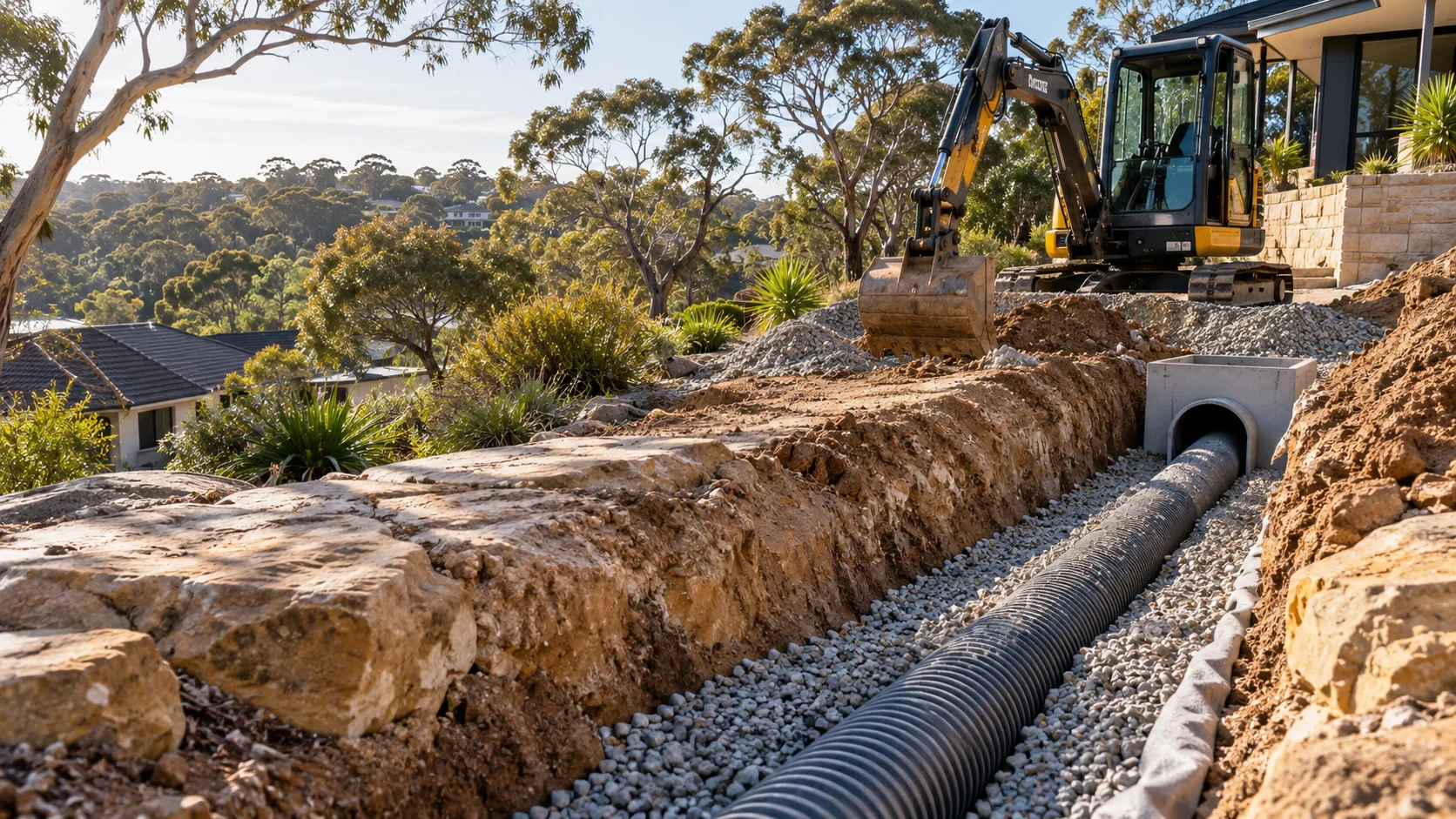
AI-generated illustration for Sutherland Shire AG Pipe Drainage Installation, inspired by Sutherland Shire, NSW
DRAINAGE & WATER MANAGEMENT

Sutherland Shire AG Pipe Drainage Installation

Plan subsoil drainage behind retaining works or around landscape areas where a designed solution is needed.

SUTHERLAND SHIRE, NSWRESIDENTIAL   /   COMMERCIALAI-generated site illustration
YOUR SITE. THE RIGHT APPROACH.

AG Pipe Drainage Installation in Sutherland Shire

Soggy lawns, wet retaining walls and damp slabs often point to hidden water, and Sutherland Shire AG Pipe Drainage Installation removes it from the ground. We install slotted pipe in gravel with correct falls and outlets.

Tell us where the problem occurs and what is nearby, such as walls, paths or buildings. Proper placement, filter cover and discharge points help the system work without clogging or causing issues elsewhere.

Across Engadine, Menai, Jannali, Caringbah and Cronulla, sloping sites and retaining walls commonly need subsoil drainage. Careful installation protects your structures and keeps your yard drier and more usable.

Explore the scope ↓
01 Site review
and access
02 Clear written
scope
03 Defined site
handover
LET'S TALK ABOUT YOUR SITE

Get A Free Estimate

Tell us about the job. Save your project details, then call us to discuss a quote.

Your brief downloads to your device. No enquiry is sent. Call 00 0000 0000 to discuss your project. Privacy information.

AG Pipe Drainage Installation Services in Sutherland

01

Slotted Pipe in Gravel

We install slotted agricultural pipe surrounded by clean gravel, behind retaining walls, along footings or across wet, boggy lawns, allowing groundwater to enter the system and drain away, relieving pressure behind walls and under slabs, saving you damp problems later.

02

Filter Cover Against Clogging

Filter fabric wrapped around the gravel prevents soil from entering the pipe, helping your drainage system work effectively for years without blockages, maintenance headaches or repeated excavation, saving you future repair costs and stress. Inspection points can also be added.

03

Reliable Outlets and Falls

Each line is laid with consistent falls and connected to a suitable outlet, such as a stormwater pit, soakwell or approved kerb outlet, ensuring collected water leaves your property without causing issues elsewhere, protecting your property and your neighbours' land.

SUBSOIL DRAINAGE

What goes behind the wall

Compacted base

The pipe sits on a firm base set to a continuous fall. It usually sits near footing level, collecting water before pressure can build up behind the wall. A soft or uneven base lets the pipe sag and trap water.

Slotted ag pipe

Perforated pipe collects water that reaches the wall. Slots generally face down, and the pipe is often wrapped in a filter sock. Use the pipe type the wall design specifies, and reject crushed or kinked lengths that slow the flow.

Free-draining gravel

Clean, washed aggregate around and above the pipe gives water a fast path. Soil mixed into it blocks the voids. Dusty or unwashed material can do the same. The gravel usually runs up behind the wall, capped below the topsoil.

Geotextile filter fabric

A fabric layer keeps fine soil out of the gravel. Without it the drain clogs gradually over a few years. Lap the joins, avoid tearing it on rock, and wrap it fully over the top of the stone before backfilling.

A proper outlet

The pipe must discharge somewhere approved, such as a stormwater pit or a point at the wall end. A drain with no outlet is a pond behind the wall. Keep the outlet visible and clear of mulch, soil and grass.

Flushing riser

A flushing riser at the high end lets the drain be checked and cleared later. Without one, a blocked pipe means digging behind the wall. Bring it up to the surface with a screw cap and note its position for future owners.

LAYING SUBSOIL DRAIN

AG Pipe Drainage Installation Experts in Sutherland Shire: How We Do The Job

  1. Set the fall and outlet

    Decide where the pipe exits first, then set a consistent fall back along the wall base. The outlet level controls how deep the drain sits at the far end, so check it works on long walls before any building starts.

  2. Trim and compact the base

    Excavate to the specified width and depth behind the wall footing, and trim the bottom to line. Compact it so the pipe will not sag. Sandy or wet ground can slump into the trench, so keep the open cut stable.

  3. Line the trench

    Place geotextile so it can wrap over the top of the gravel later. Leave enough fabric on both sides to overlap well, and keep it against the trench sides so it does not bunch or tear when stone goes in.

  4. Lay pipe and cover in gravel

    Lay the pipe on a bed of aggregate and cover to the specified depth. Check the slots face as the design shows, join lengths with fittings, and run the pipe to the outlet without kinks. Keep soil off the stone.

  5. Test the flow

    Pour water in at the high end and watch it come out the outlet before backfilling above. Slow or no flow points to a sag, blockage or crushed section, and fixing it now beats digging out behind a finished wall.

WHEN SUBSOIL DRAINS FAIL

Common AG Pipe Drainage Installation Mistakes in Sutherland Shire: How To Handle Them

01

Slots facing up

Installed the wrong way, the pipe can fill with silt and hold standing water at the bottom. It is easy to miss, because the drain looks finished once covered in gravel. Ask which way the slots face on your design.

02

Dirt in the gravel

Backfilling by tipping soil straight on the aggregate buries the filter. Fabric should be wrapped over the stone first. Machines tracking over open gravel, or muddy runoff washing in during a storm mid-job, can contaminate the stone just as quickly.

03

No fall, no outlet

A flat pipe or one that ends against the wall just stores water. With nowhere to go, saturated soil behind it adds pressure the wall was not designed to carry. The drain needs a continuous fall to a clear outlet.

04

Roof water into the ag pipe

Ag pipe is for groundwater, not stormwater from downpipes. Piping roof water into it overloads the drain. Water then forces out through the slots into the soil behind the wall, saturating it further. Roof water belongs in sealed stormwater pipe.

WHY CHOOSE US FOR AG PIPE DRAINAGE INSTALLATION

Why Choose Our AG Pipe Drainage Installation Experts

Wet lawns, damp slabs and failing retaining walls often point to hidden groundwater, and our AG pipe experts know how to remove it. We install slotted pipe in clean gravel with filter fabric, consistent falls and a suitable outlet, so water drains away without blocking or causing problems elsewhere. Clear communication helps you understand where the problem is and how we will fix it. With local knowledge of Sutherland Shire sloping sites, clay soils and retaining walls, we deliver reliable subsoil drainage that protects your home and structures, keeps your whole yard drier and saves you from costly repeated repairs.

Talk to our team ↗
AI-generated illustration of ag pipe drainage installation works in Sutherland Shire
WHERE AG PIPE SITS

Behind a wall or across a yard

Behind a retaining wall

  • Follows the design of the engineer or wall supplier
  • Needs gravel, fabric and a drained base
  • Outlet at the wall end or into a pit
  • Protects the wall from water pressure

Cutting off wet ground

  • Intercepts seepage coming down a slope or toward a house
  • Placed uphill of the wet area
  • Often paired with surface drains
  • Works only if the water source is subsoil

Same pipe, different job. Work out which one you need before digging.

ASKED ABOUT AG PIPE DRAINAGE INSTALLATION

Frequently
Asked Questions

Groundwater conditions, filter material and outlet position.

Ask us about your project ↗
01Does my retaining wall need ag pipe?+

Almost always yes. Whatever the wall type, drainage behind it is critical, and the wall design or engineer will specify it. Do not leave it out to save cost.

02Can ag pipe connect to the stormwater system?+

Typically yes, via a pit or an approved connection. A licensed plumber should do the connection, and it must not go to the sewer.

03How long does the gravel last?+

It can last for decades if the fabric is intact and the outlet stays clear. Poor installation is the usual reason it fails early.

04Can you retrofit a drain behind an existing wall?+

Sometimes, by digging down the back of the wall, though it can be difficult and may affect the wall. An engineer should check first.

DRAINAGE & WATER MANAGEMENT

Let’s start your ag pipe drainage installation project.

Share the address, the access and the result you need.
Details first. Then a plan that suits the site.

Start a conversation ↗00 0000 0000