CONSIDERED DEMOLITION. EXCEPTIONAL POSSIBILITIES.LET’S TALK ABOUT YOUR SITE ↗ 00 0000 0000
Sutherland Shire Demolition
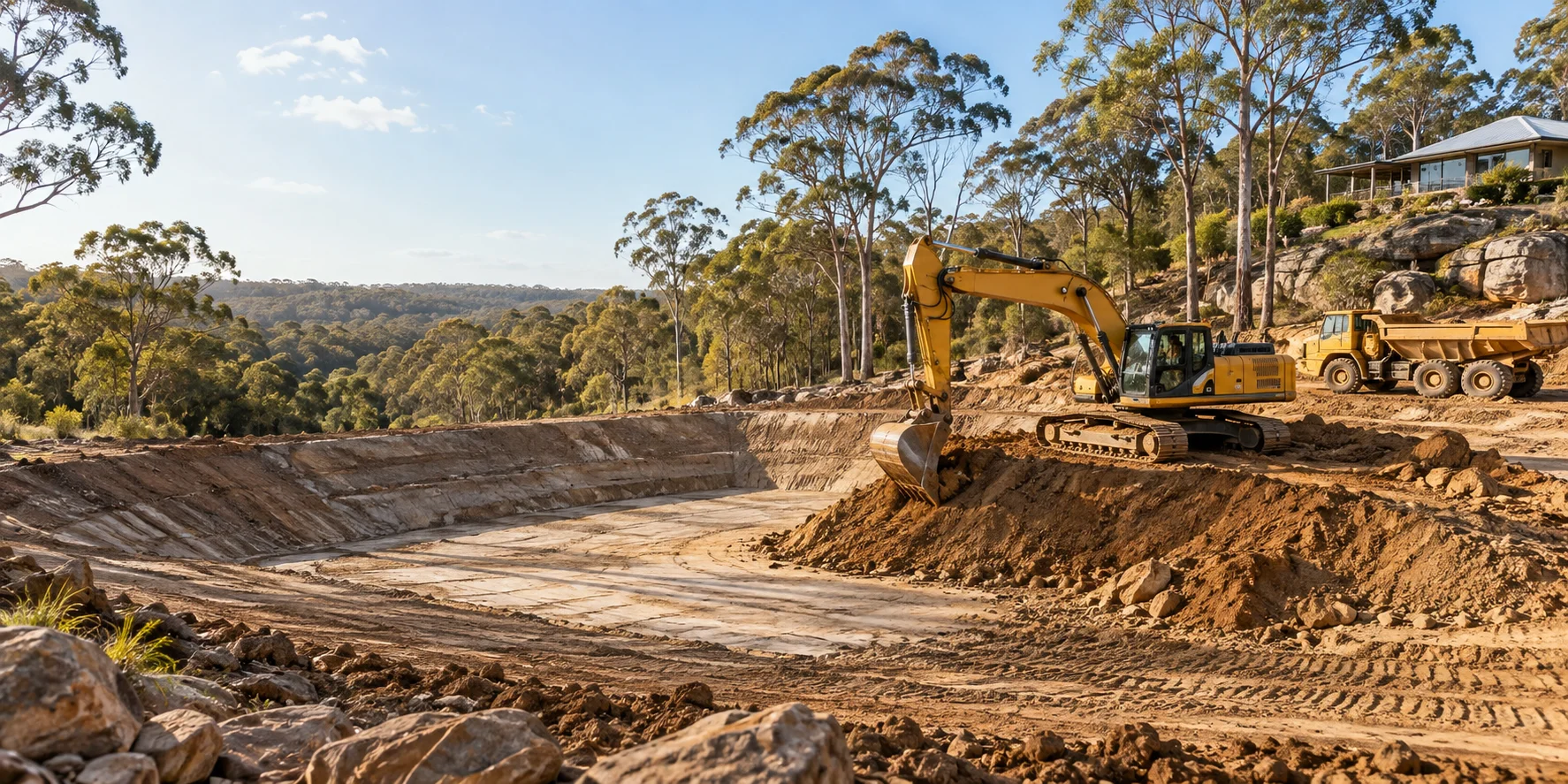
AI-generated illustration for Sutherland Shire Dam Construction / Dam Digging, inspired by Sutherland Shire, NSW
EXCAVATION

Sutherland Shire Dam Construction / Dam Digging

Assess dam earthworks against site suitability, design information and water-management requirements.

SUTHERLAND SHIRE, NSWRESIDENTIAL   /   COMMERCIALAI-generated site illustration
YOUR SITE. THE RIGHT APPROACH.

Dam Construction / Dam Digging in Sutherland Shire

A well-built dam supports water storage, stock and landscape value, and Sutherland Shire Dam Construction and Dam Digging starts with careful design and ground assessment. We excavate, shape and compact to give your dam sound walls and capacity.

Tell us the property layout, intended use and water source. Correct sizing, spillway planning and soil selection help your dam hold water, manage overflow and stay stable through heavy rain.

For larger holdings around Engadine, Heathcote, Menai and the Shire's rural edges, local conditions matter. Experienced operators plan the dig, protect surrounding land and deliver a practical, long-lasting water feature.

Explore the scope ↓
01 Site review
and access
02 Clear written
scope
03 Defined site
handover
LET'S TALK ABOUT YOUR SITE

Get A Free Estimate

Tell us about the job. Save your project details, then call us to discuss a quote.

Your brief downloads to your device. No enquiry is sent. Call 00 0000 0000 to discuss your project. Privacy information.

Dam Construction and Dam Digging Services in Sutherland

01

Site and Soil Assessment

We assess the land, soil type and water source before digging, checking that the ground holds enough clay to seal properly, helping your dam hold water effectively and remain stable through both heavy rain and dry periods for years ahead.

02

Shaping and Compaction

Dam walls and floors are shaped and compacted carefully, with suitable clay placed in layers and keyed into place, creating strong embankments that resist erosion, seepage and failure over the long term, ensuring your dam lasts for decades to come.

03

Spillway and Overflow Planning

Heavy rain must have somewhere to go, so we plan spillways and overflow paths that protect the dam wall and surrounding land from damage, even during prolonged heavy rain events. Spillways are set to direct water safely past the wall.

APPROVALS FIRST

Water rules apply before the digging

Dams in NSW are covered by water management rules, including limits on how much runoff a rural property can capture (the harvestable right), and Council approval may be needed. Sutherland Shire is largely urban, so dams mainly suit fringe properties.

  • Ask Council and the relevant NSW water authority what applies to your property
  • Works in or near a waterway may need further permission
  • Keep approval documents with the design
DAM ANATOMY

Parts of a well-built dam

Keyway

A trench cut into solid ground beneath the embankment and filled with compacted clay, so water cannot creep under the wall. It should run the full length of the wall and be dug through any sandy or permeable layers below.

Embankment

The compacted wall that holds the water. It is built up in thin layers, each one rolled before the next. The best clay usually goes in the core, and the finished height should allow for settlement and the required freeboard.

Spillway

A stable channel that lets overflow leave safely instead of eroding through the wall during heavy rain. It is cut into natural ground beside the wall, sized to the catchment and grassed or rock-lined so flows do not scour it.

Outlet pipe

A pipe through the wall for controlled release or drawdown, with bedding and seepage collars as designed. Poorly compacted soil around the pipe is a common leak path, so backfill is placed carefully in thin, even layers and well compacted.

Catchment

The land that feeds the dam. Its size and slope determine inflow and sediment load. Too small a catchment and the dam rarely fills, while a large one needs a bigger spillway and better erosion control upstream of the water.

Wall batters

The sloped faces of the wall need gentle enough grades to stay stable when wet and to be mown safely. The upstream face takes wave action, while the downstream face should be grassed and kept free of trees whose roots open leak paths.

DAM VOCABULARY

Dam Construction / Dam Digging Terms That You Need To Know

Keyway
The cut-off trench under the embankment that seals it to the natural ground. It is dug down into impermeable material and backfilled with compacted clay, giving water no easy path to seep beneath the wall and weaken it over time.
Freeboard
The height between normal water level and the top of the wall, left as a safety margin. It allows for waves, flood flows and settlement, so the wall is not overtopped when the spillway is carrying water in a storm.
Turkey nest
A dam built up above ground with banks all round, used where there is no natural gully. It is usually filled by pumping, and because the whole storage sits above ground, the banks need careful compaction and good quality clay.
Dispersive clay
Clay that breaks down in water and can cause tunnel erosion, so it needs testing or treatment. A simple soil test can identify it, and treatment with gypsum or capping with better clay may be recommended by a soil specialist.
DAM BUILD SEQUENCE

Dam Construction / Dam Digging Experts in Sutherland Shire: How We Do The Job

  1. Assess the site

    Test the soil for clay content, check catchment and confirm there is a suitable place for the wall and spillway. Test pits across the site show whether good clay runs deep enough, and whether rock or sand will cause leaks.

  2. Peg out the dam

    The wall centreline, crest height, spillway level and full water line are pegged on the ground. Walking the pegged water line shows how much land will go under water, and whether fences, tracks or trees sit inside the storage area.

  3. Protect the watercourse

    Sediment fencing and other controls go in downstream before any ground is opened, so disturbed soil does not wash into creeks or neighbouring land. Keep machines out of the flow line where possible, and plan crossings in line with any waterway approval.

  4. Strip and cut the keyway

    Topsoil and organic matter are removed under the wall footprint, and the keyway is dug into firm ground. Stripped topsoil is stockpiled for later use on the finished batters, where it helps grass establish and protects the wall from erosion.

  5. Dig the storage

    The basin is excavated to the design depth and batter slopes, with suitable clay moved straight to the wall as it comes out. Sand or gravel pockets found in the floor are dug out and lined with compacted clay so the storage holds water.

  6. Build the embankment

    Suitable clay is placed in thin layers and compacted, with moisture control to get a tight, stable wall. Clay that is too dry will not bind, and clay that is too wet will not compact, so timing around weather matters.

  7. Place the outlet

    Pipework is bedded and sealed through the wall to the design, a common weak point if rushed. Soil around the pipe should be compacted in thin layers, and any seepage collars or filters fitted exactly as the design shows them.

  8. Finish the spillway and surfaces

    The spillway is shaped and stabilised, and bare batters are covered with vegetation or rock to resist erosion. Keep stock and vehicles off new surfaces until cover establishes, and inspect the wall after the first good fill for any seepage.

WHY DAMS FAIL

Common Dam Construction / Dam Digging Mistakes in Sutherland Shire: How To Handle Them

01

Sandy or shaley soil

Soil that will not hold water makes a dam that will not fill. Test before committing. Test pits across the dam site, below the planned floor level, show whether clay is consistent or interrupted by sand, gravel or fractured rock.

02

No spillway

Water overtopping the wall can erode it quickly. A spillway sized to the catchment is part of the design. It should sit on natural ground, not fill, and carry flows well clear of the embankment toe and any downstream structures.

03

Organic material in the wall

Roots, topsoil and turf in the embankment rot and leave voids, causing leaks. Strip them out first. That includes old stumps and large roots under the wall footprint, which should be grubbed out and the holes filled with compacted clay.

04

Poor compaction

Thick, uncompacted layers settle and leak. Ask how layers will be placed and compacted. Track rolling alone may not be enough for a water-holding wall, and moisture content affects results, so ask what compaction equipment and checks will be used.

WHY CHOOSE US FOR DAM CONSTRUCTION / DAM DIGGING

Why Choose Our Dam Construction and Dam Digging Experts

A dam must hold water reliably for years, and that starts with experienced design and construction. Our dam experts assess the land, soil type and water source before digging, then shape and compact walls and floors to resist erosion and seepage. We plan spillways and overflow paths so heavy rain cannot damage the wall or surrounding land. Clear communication and honest advice help you choose a size and location that suits your needs. With local knowledge of Sutherland Shire rural conditions, we deliver practical, long-lasting dams that protect your property and give you dependable water storage. We keep you informed.

Talk to our team ↗
AI-generated illustration of dam construction / dam digging works in Sutherland Shire
BEFORE DAM DIGGING

Dam project checklist

  • Water rules and Council approval requirements confirmed
  • Design or sketch shows wall, keyway, outlet and spillway
  • Soil suitability checked, ideally by testing
  • Catchment and flow paths understood
  • Machine access to the site confirmed
  • Downstream neighbours and watercourses considered
  • Spoil and topsoil placement agreed
  • Weather window planned for wall compaction
ASKED ABOUT DAM CONSTRUCTION / DAM DIGGING

Frequently
Asked Questions

Soil suitability, design levels and relevant approvals.

Ask us about your project ↗
01Do I need approval to build a dam?+

It depends on the property, the size and where it sits relative to a watercourse. Check with Council and the relevant NSW water authority before starting.

02How big can a farm dam be?+

Rural properties have harvestable right limits that cap how much runoff can be captured. The limit depends on the property and rules at the time, so confirm it directly.

03Will my soil hold water?+

Clay-rich soil usually does, while sandy or shaley soil may not. A soil test or an experienced operator reading test pits will tell you more than guessing.

04Can you dig a dam on a suburban block?+

Generally no. Most suburban lots have no suitable catchment, and Council rules apply. A rainwater tank or approved on-site system is a more typical option.

EXCAVATION

Let’s start your dam construction / dam digging project.

Share the address, the access and the result you need.
Details first. Then a plan that suits the site.

Start a conversation ↗00 0000 0000