CONSIDERED DEMOLITION. EXCEPTIONAL POSSIBILITIES.LET’S TALK ABOUT YOUR SITE ↗ 00 0000 0000
Sutherland Shire Demolition
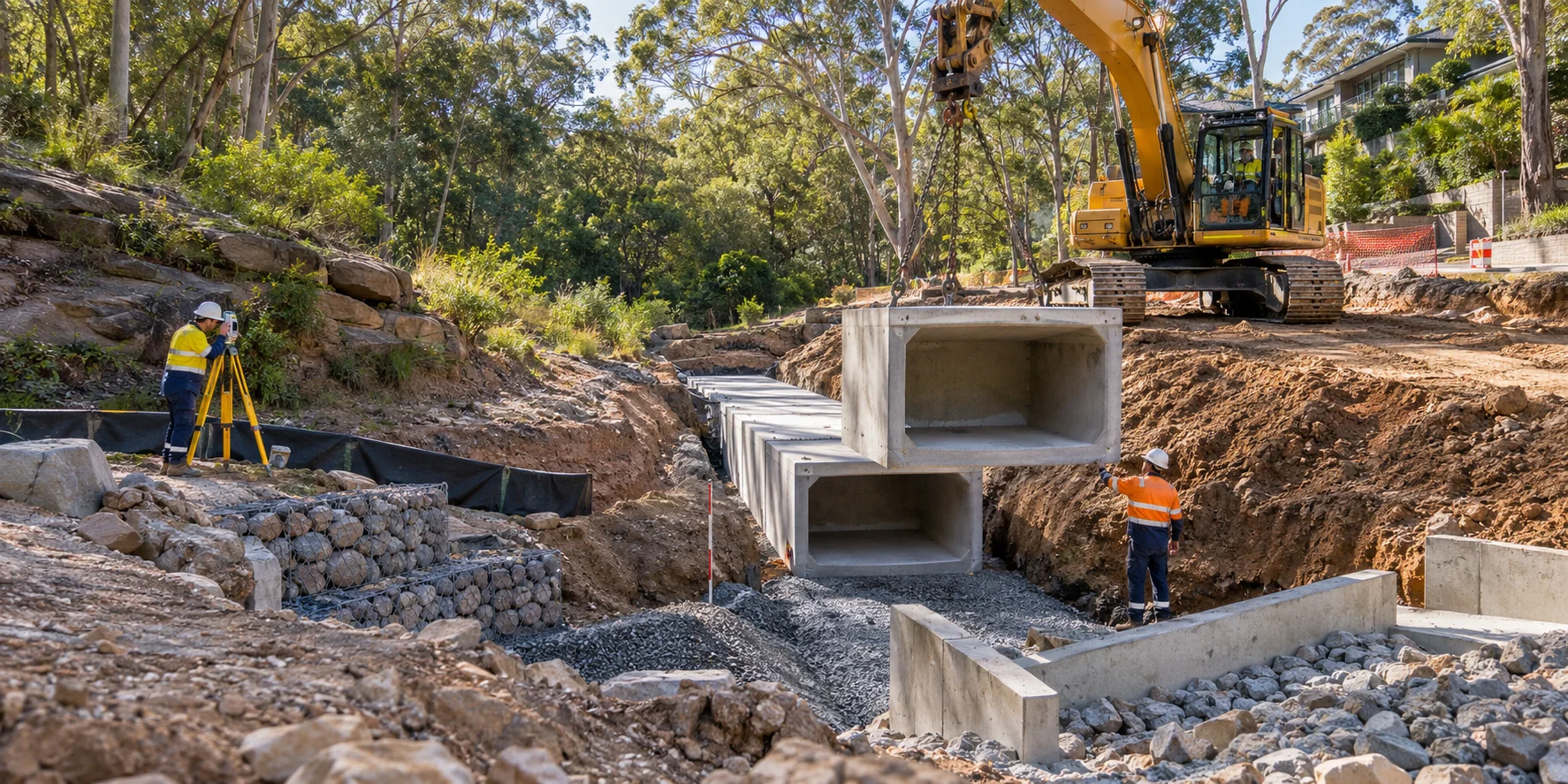
AI-generated illustration for Sutherland Shire Culvert Installation, inspired by Sutherland Shire, NSW
CIVIL & UTILITY WORKS

Sutherland Shire Culvert Installation

Plan culvert earthworks to support access and controlled water movement.

SUTHERLAND SHIRE, NSWRESIDENTIAL   /   COMMERCIALAI-generated site illustration
YOUR SITE. THE RIGHT APPROACH.

Culvert Installation in Sutherland Shire

Water needs somewhere to go, and Sutherland Shire Culvert Installation makes sure it passes safely under driveways, access tracks and roads. We excavate, bed, lay and backfill culverts to the right levels and falls.

Share your site layout, pipe size and flow requirements. Correct placement, cover and compaction help your culvert handle heavy rain and vehicle loads without washing out or collapsing.

For properties around Engadine, Heathcote, Menai and the Shire's bushland edges, creeks and runoff are real considerations. Experienced operators install culverts that protect your access and keep stormwater moving as intended.

Explore the scope ↓
01 Site review
and access
02 Clear written
scope
03 Defined site
handover
LET'S TALK ABOUT YOUR SITE

Get A Free Estimate

Tell us about the job. Save your project details, then call us to discuss a quote.

Your brief downloads to your device. No enquiry is sent. Call 00 0000 0000 to discuss your project. Privacy information.

Culvert Installation Services in Sutherland

01

Correct Levels and Falls

We excavate and set culverts at the right levels and falls, aligned with the natural flow of water across your land, ensuring water flows freely under your driveway or access track without pooling or backing up, even during heavy storms.

02

Bedding, Cover and Compaction

Pipes are properly bedded and covered with compacted material to a suitable depth, allowing the culvert to carry vehicle loads and heavy rain without cracking, sinking or washing out, saving you costly repairs later. Rock headwalls can also be added.

03

Protection for Access and Waterways

A well-installed culvert protects your access from washouts and keeps stormwater moving as intended, with rock protection at the inlet and outlet where needed, reducing erosion and safeguarding nearby creeks, bushland and neighbouring land, protecting your investment for many years.

PIPE OR BOX

Pipe culvert versus box culvert

The right shape depends on the flow, the cover over the top and the vehicles using the crossing.

Pipe culvert

  • Commonly used for smaller driveway crossings
  • Usually quicker to lay, in sections
  • Needs enough cover above the pipe for the loads
  • Smaller waterway opening for a given depth

Box culvert

  • Wider, flatter opening suits shallow, wide flows
  • Often precast, so it needs lifting and a firm, level base
  • Can handle heavier loads when designed for them
  • Usually more involved to bed and place

A hydraulic design decides it. Size and type should not be guessed from the pipe someone has available.

WATER, THEN WEIGHT

Culvert Installation Experts in Sutherland Shire: How We Do The Job

  1. Design and consent

    The pipe size, invert levels and cover come from a design. Works in or near a waterway may need Council consent, and for some creeks, NSW Fisheries or DCCEEW permission. Allow time for approvals before booking machines or ordering pipes.

  2. Locate services and access

    Lodge Dial Before You Dig and check the plans, because water, power and communications often cross near driveway entries. Plan where the machine, trucks and any crane will stand, and keep them back from soft creek banks that can give way.

  3. Divert and dewater

    The creek or drain needs controlling so the trench can be dug and the pipes laid. Sediment control stops muddy water leaving the site. Flows are usually piped or pumped around the work, with a plan for sudden storm flows.

  4. Excavate and prepare base

    Dig to the design levels. Soft or wet ground may need to be removed and replaced with a stable bedding, sometimes with geotextile. The base should be firm along its full length so the culvert does not sag or crack.

  5. Place the culvert

    Pipes or boxes are laid to the specified fall and joined. Larger units need lifting equipment, a lift plan and a competent dogman. Joints should be properly sealed or wrapped as specified so surrounding soil cannot wash into the pipe.

  6. Backfill in layers

    Material goes both sides evenly, in thin layers, so the culvert is not pushed sideways or crushed. Compaction close to the culvert uses lighter equipment, and heavy machines stay off until the minimum cover is in place over the culvert.

  7. Inlet and outlet protection

    Rock or headwalls at each end stop the stream from scouring around and under the pipe. Rock should be sized and bedded on geotextile so it stays put in floods, and grassed or planted banks help stabilise the disturbed ground.

  8. Finish the crossing

    Road base is placed and compacted over the cover, then sealed, concreted or gravelled as agreed. Guide posts or edge markers show drivers where the crossing ends, and the surface should shed water to the sides rather than down the track.

WHY CULVERTS FAIL

Common Culvert Installation Mistakes in Sutherland Shire: How To Handle Them

01

Undersized pipe

A pipe that is too small can back up and flood upstream, or overtop the crossing. Rely on a hydraulic design, not a guess. Ask what storm the pipe is sized for, as upstream development can increase flows over time.

02

Scour at the outlet

Fast water leaving the pipe digs a hole and undermines it. Rock protection or a headwall at the outlet is not optional. Check the outlet after the first heavy rain and repair early erosion before it spreads under the crossing.

03

Not enough cover

Too little material above the pipe can crack it under a vehicle. Check the minimum cover for the pipe type and the loads. Where cover is limited, a stronger pipe class or a slab over the top may be needed.

04

Blocked by debris

Leaves, branches and silt can block the inlet. Plan for access to clean it, and ask whether a grate or trash screen is needed. A blocked inlet forces water over the driveway, so inspect it regularly, especially before storm season.

05

Skipping approvals

Working in a watercourse without the required consent can lead to stop-work orders and removal. Check with Council early. Changes to a creek can also affect neighbours and downstream properties, so neighbour disputes, not just penalties, are a real risk.

06

Water tracking along the pipe

Water can seep along the outside of a pipe through loose backfill, carrying soil with it until a hole opens above. Good compaction around the haunches helps, and the design may call for cut-off walls or collars to block the seepage path.

DRAINAGE LANGUAGE

Culvert Installation Terms That You Need To Know

Invert level
The level of the bottom inside the pipe, set at inlet and outlet. The difference between the two gives the fall, which keeps water moving steadily and helps the pipe flush silt instead of collecting it in a low spot.
Headwall
A wall at the end of the culvert that holds the embankment and guides water. Headwalls are often precast or formed in reinforced concrete, and they protect the pipe ends from scour and from damage by passing vehicles or mowers.
Scour
Erosion caused by fast water, especially at the outlet. Scour starts as a small hole below the pipe and can grow quickly in storms, undermining the culvert, the headwall and eventually the driveway or track above. Rock protection limits it.
Cover
The depth of material between the top of the pipe and the road or driveway surface. Enough cover spreads wheel loads so the pipe is not crushed. The pipe supplier or designer states the minimum cover needed for the loads.
Bedding
The prepared base the pipe sits on, which spreads loads evenly. It is usually a compacted granular material shaped to support the pipe along its full length, and it must not be soft, wet, uneven or full of large rocks.
WHY CHOOSE US FOR CULVERT INSTALLATION

Why Choose Our Culvert Installation Experts

A culvert protects your access from washouts and keeps stormwater moving, so correct installation is essential. Our culvert experts excavate, set levels and falls accurately and bed pipes properly before covering and compacting in layers. This allows the culvert to carry vehicle loads and heavy rain without cracking, sinking or blocking. Clear communication helps you choose the right pipe size and design for your flow requirements. With local knowledge of Sutherland Shire creeks, bushland edges and runoff patterns, we deliver durable, well-engineered installations that protect your driveway, neighbouring land and local waterways, giving you dependable, long-term performance season after season.

Talk to our team ↗
AI-generated illustration of culvert installation works in Sutherland Shire
BEFORE WORK STARTS IN THE CREEK LINE

Culvert planning checklist

  • Hydraulic design with pipe size and levels
  • Council consent, and any other permits, confirmed
  • Sediment and flow control plan
  • Lifting and access plan for the pipes or boxes
  • Dial Before You Dig plans checked
  • Weather forecast reviewed
  • Access to clean the inlet later
  • Spoil and surplus material destination decided
ASKED ABOUT CULVERT INSTALLATION

Frequently
Asked Questions

Hydraulic design, bedding and inlet and outlet levels.

Ask us about your project ↗
01Do I need approval to install a culvert?+

Often yes, especially when it is in or near a watercourse. Council consent may be needed, and for some creeks, NSW Fisheries or DCCEEW permission. Check before any digging.

02How do I know what size pipe to use?+

A hydraulic design based on the catchment and flows decides it. A civil or hydraulic engineer can provide that.

03Can the culvert be installed in wet weather?+

It is much harder. Wet ground makes the base soft and the flows bigger, and sediment control becomes critical. Dry weather windows are usually better.

04How long does a driveway culvert last?+

It depends on the material, installation quality and maintenance. Keeping the inlet clear and the outlet protected makes the biggest difference.

CIVIL & UTILITY WORKS

Let’s start your culvert installation project.

Share the address, the access and the result you need.
Details first. Then a plan that suits the site.

Start a conversation ↗00 0000 0000