CONSIDERED DEMOLITION. EXCEPTIONAL POSSIBILITIES.LET’S TALK ABOUT YOUR SITE ↗ 00 0000 0000
Sutherland Shire Demolition
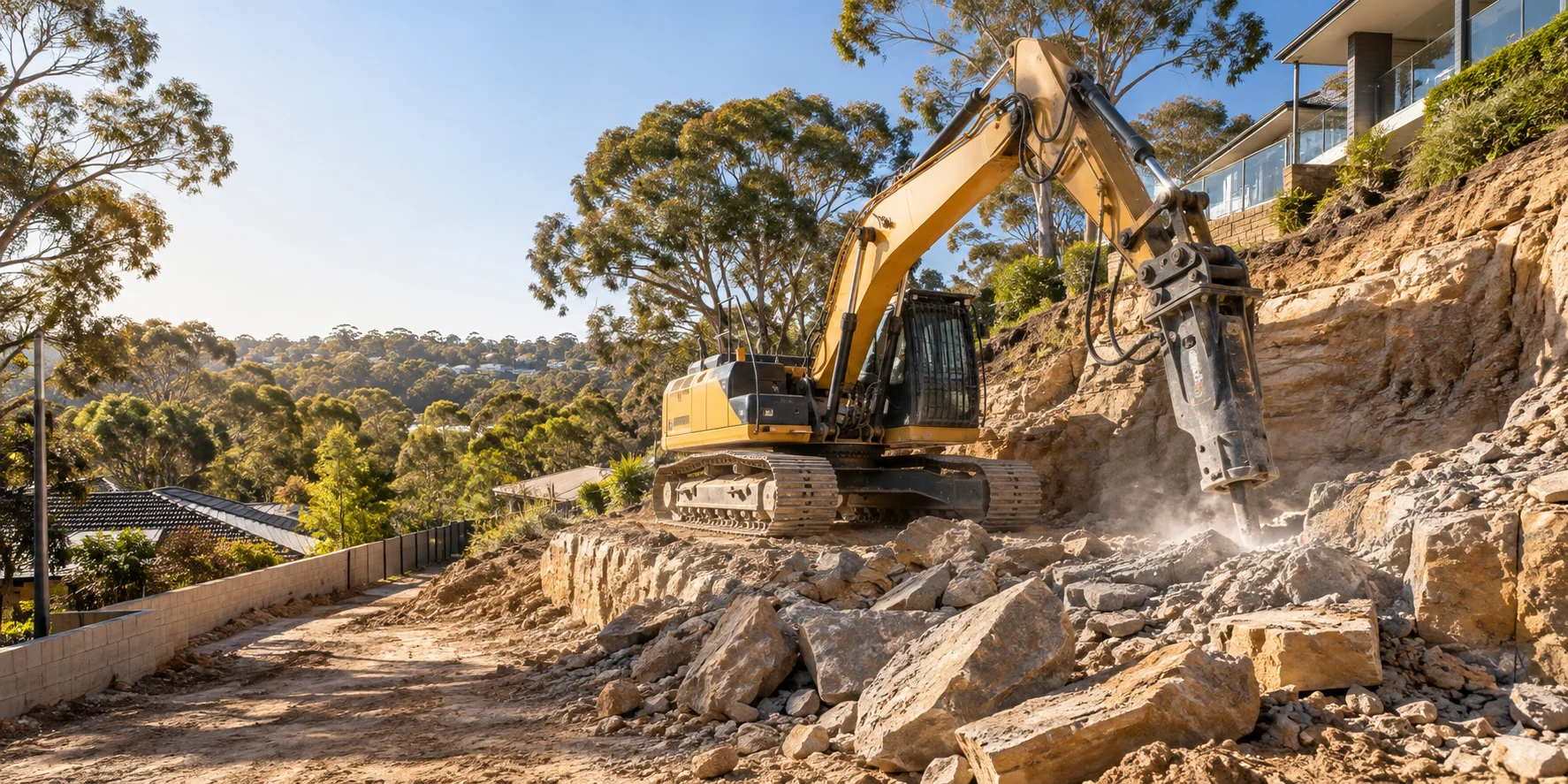
AI-generated illustration for Sutherland Shire Rock Excavation, inspired by Sutherland Shire, NSW
EXCAVATION

Sutherland Shire Rock Excavation

Work through rocky ground with a method matched to the excavation design and surrounding property.

SUTHERLAND SHIRE, NSWRESIDENTIAL   /   COMMERCIALAI-generated site illustration
YOUR SITE. THE RIGHT APPROACH.

Rock Excavation in Sutherland Shire

When the ground turns to sandstone, Sutherland Shire Rock Excavation needs the right equipment and a controlled approach. We break, excavate and remove rock to your levels, keeping vibration, noise and dust in check.

Share your plans, depth requirements and site access. Early identification of rock helps us select the right method, whether hydraulic breakers or larger excavators, and avoids expensive delays once your build is underway.

Across Cronulla, Caringbah, Miranda, Engadine and Sutherland, shallow rock is part of everyday building. Local experience allows us to plan for it, protect neighbouring properties and leave a clean, accurate excavation.

Explore the scope ↓
01 Site review
and access
02 Clear written
scope
03 Defined site
handover
LET'S TALK ABOUT YOUR SITE

Get A Free Estimate

Tell us about the job. Save your project details, then call us to discuss a quote.

Your brief downloads to your device. No enquiry is sent. Call 00 0000 0000 to discuss your project. Privacy information.

Rock Excavation Services in Sutherland

01

Method Matched to Rock Type

We assess the rock and select hydraulic breakers or larger excavators accordingly, with rock saws used where clean cut faces are needed, balancing speed, accuracy and control, so the excavation proceeds efficiently and safely, saving you valuable time and money.

02

Vibration, Noise and Dust Control

Rock excavation can disturb surroundings, so we manage vibration, noise and dust carefully, with water suppression, rock sawing and agreed daily working hours, protecting neighbouring properties and keeping the work within acceptable limits, throughout every single stage of the excavation.

03

Accurate Levels and Clean Removal

Rock is excavated to your required levels and removed from site, with rock faces trimmed neatly where they will remain exposed, leaving a clean, accurate excavation ready for footings, pools, services or retaining walls, all completed to your engineer's requirements.

METHODS FOR SANDSTONE

Break it, saw it or split it

Hydraulic rock breaker

  • Fits to an excavator and suits most open sites
  • Fast on larger volumes of rock
  • Loud, with ground vibration that carries to neighbours
  • Edges are rough, so over-break is common

Saw or split

  • Rock saws cut clean lines near boundaries and structures
  • Splitting or expanding agents crack rock without impact noise
  • Slower and more expensive per cubic metre
  • Better where vibration and noise limits are tight

Blasting is a specialist option and rare in suburbia. On a typical residential lot, expect breaker, saw or splitting, or a mix.

READING THE ROCK

What rock looks like on site

Floaters

Loose boulders sitting in soil. They can be pulled out or broken, and often signal rock below, but not always. Large floaters are awkward to load, and may be worth keeping for landscaping if there is room to store them.

Bedded benches

Flat layers of sandstone that break along natural joints. These can be easier to remove than massive rock. Bedding planes can also make cut faces shed slabs, so faces need checking and loose pieces removed as the dig goes down.

Weathered edges

Softer, crumbly rock near the surface that digs easily, then gives way to much harder rock beneath. This change can catch out a quote based on a quick look, so ask how far the test pits or boreholes actually went.

Seepage along joints

Water moves through cracks in the rock and can appear in the cut as seepage, even after dry weather. Plan for drainage behind walls and under slabs, and mention any seepage to the engineer, since it affects waterproofing and design.

ROCK DIG SEQUENCE

Rock Excavation Experts in Sutherland Shire: How We Do The Job

  1. Probe and expose

    Test pits or a geotechnical report show how deep and how hard the rock is before the main job is priced. One test pit may not represent the whole site, so several locations give a better picture of the rock.

  2. Record neighbours

    Photograph or survey nearby structures and agree vibration limits before breaking starts. A formal dilapidation report gives an independent record, and talking to neighbours about timing and duration helps reduce complaints and disputes once the noise of rock breaking begins.

  3. Break, saw or split

    The chosen method removes rock in controlled sections, working away from the structures you want to protect. Saw cuts along boundaries can isolate the work zone first, reducing vibration and over-break before the main mass of rock is broken out.

  4. Load and cart

    Broken rock is heavy and awkward. It needs strong buckets, trucks and an access route that supports the load. Rock is denser than most soil, so trucks often reach their weight limit before they look full, adding to the loads.

  5. Trim to profile

    Final faces and floor are trimmed to the design levels, with rock faces left stable and free of loose pieces. The engineer may inspect exposed faces and advise on bolting, shotcrete or drainage where joints or weak layers show up.

NOISE AND VIBRATION

Rock work is the loudest job in earthworks

Rock breaking produces noise and vibration that neighbours feel. Construction noise guidelines recommend work between 7 am and 6 pm weekdays and 8 am to 1 pm Saturdays, with no work Sundays or public holidays. Approval conditions may be tighter.

  • Tell neighbours well before breaking starts
  • Ask whether vibration monitoring is appropriate near sensitive structures
  • Use saw or splitting methods close to boundaries if limits are tight
ROCK RISKS

Common Rock Excavation Mistakes in Sutherland Shire: How To Handle Them

01

Rock not allowed for in the quote

Ask whether the price assumes soil only and how rock is charged if found. Hourly or per-cubic-metre rates are common ways to handle it. Get the rate in writing, along with how the rock quantity will be measured and agreed.

02

Breaker used too close to walls

Impact can crack neighbouring brickwork and footings. Use controlled methods near structures. Saw cutting, splitting or a smaller breaker can reduce vibration, and monitoring can show whether limits are being kept when work is close to older or sensitive buildings.

03

Underestimating the volume

Rock volume depends on the surface, which is often irregular. Ask how it will be measured. Survey before and after, or counting truck loads, are common methods, but agree which one applies before work starts to avoid disputes later on.

04

Loose rock left on the face

Cut faces can shed pieces after rain. Have loose material scaled off and ask the engineer about support where needed. Keep people and stockpiles clear of the base of tall faces, and check them again after storms or heavy breaking.

WHY CHOOSE US FOR ROCK EXCAVATION

Why Choose Our Rock Excavation Experts

When ground turns to sandstone, you need excavation experts with the right equipment and a controlled approach. We assess the rock first, then choose hydraulic breakers or larger excavators to suit the job, balancing speed, accuracy and safety. Vibration, noise and dust are carefully managed to protect neighbouring properties and structures. We keep the site safe. Clear communication means no surprises about timing or cost. With extensive local experience of Sutherland Shire rock, we plan for it from the start, excavating to your required levels and removing material cleanly, so footings, pools, services or retaining walls can proceed on schedule.

Talk to our team ↗
AI-generated illustration of rock excavation works in Sutherland Shire
ROCK WORDS

Rock Excavation Terms That You Need To Know

Hawkesbury Sandstone
The sedimentary rock that underlies much of Sydney and the Shire, often close to the surface. It ranges from soft and weathered to very hard, and its depth can change sharply across a single block, which complicates pricing and planning.
Floater
A loose boulder resting in soil rather than attached to bedrock. Floaters can usually be lifted or broken without heavy rock work, but finding several in a dig often suggests that solid bedrock may lie not far below the surface.
Over-break
Rock removed beyond the planned line, common with impact breaking. It can leave uneven faces, extra voids to fill behind walls and additional concrete under slabs, which is why saw cutting is often used along critical edges and site boundaries.
Expanding agent
A chemical grout placed in drilled holes that swells and cracks rock without impact or blasting. It works slowly, usually over several hours, and suits sites where vibration and noise must stay low, such as near neighbours or sensitive structures.
ASKED ABOUT ROCK EXCAVATION

Frequently
Asked Questions

Rock profile, equipment access and neighbouring structures.

Ask us about your project ↗
01How do I know if there is rock under my block?+

Sandstone is common across the Shire, especially on sloping and bushy sites. A geotechnical report, test pit or probing shows depth, but the true extent is often only known once digging starts.

02Will rock breaking crack my neighbour house?+

Vibration from breaking can affect nearby structures. Use a suitable method, agree limits where needed and consider a before-and-after condition record.

03Can I keep the sandstone?+

Often yes. Sandstone blocks can be reused for landscaping or walls if you ask in advance and have space to store them.

04Why is rock more expensive than soil?+

It takes specialist attachments, more time and more wear on machines, and the material is harder to load and cart.

EXCAVATION

Let’s start your rock excavation project.

Share the address, the access and the result you need.
Details first. Then a plan that suits the site.

Start a conversation ↗00 0000 0000