CONSIDERED DEMOLITION. EXCEPTIONAL POSSIBILITIES.LET’S TALK ABOUT YOUR SITE ↗ 00 0000 0000
Sutherland Shire Demolition
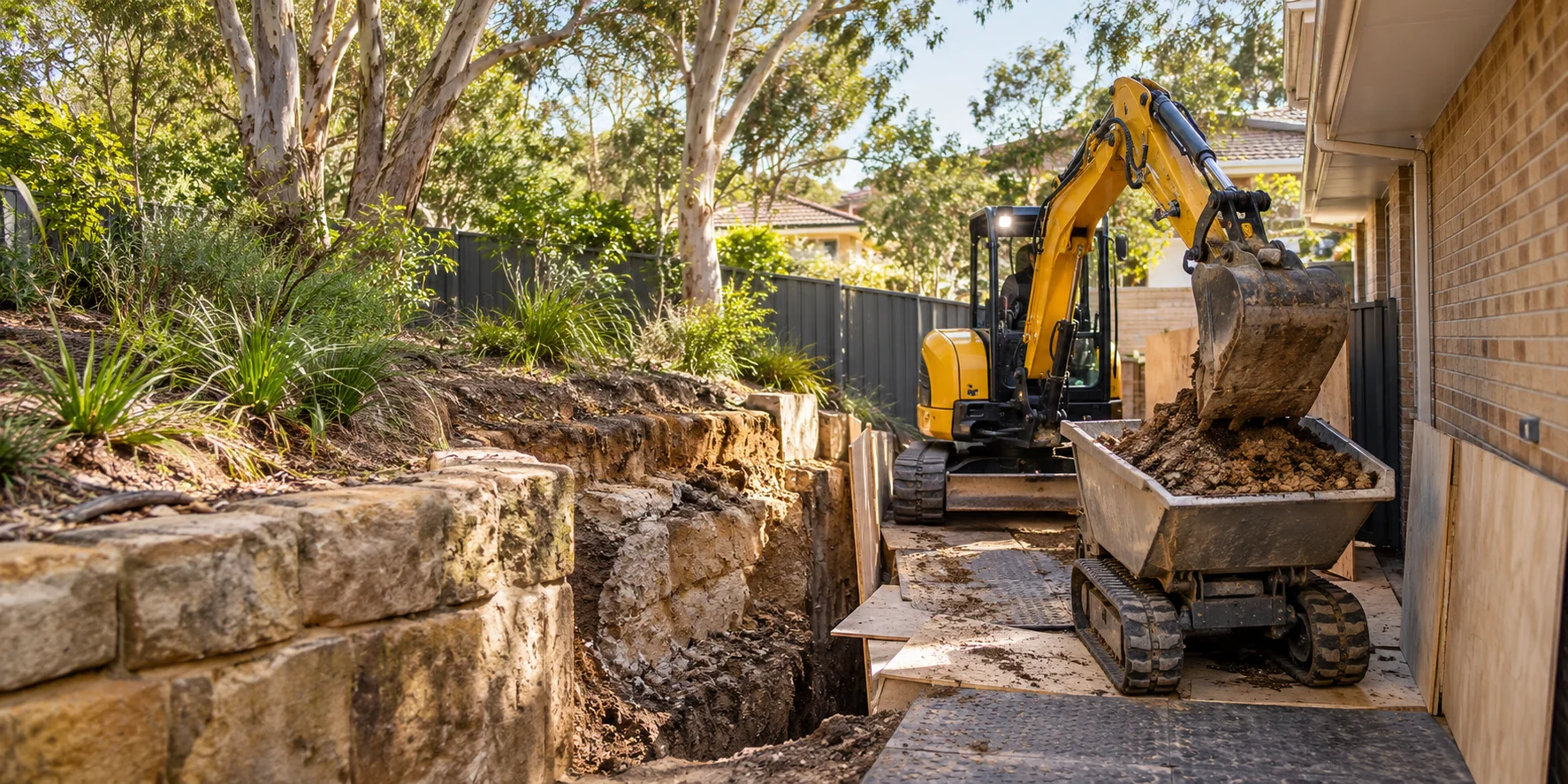
AI-generated illustration for Sutherland Shire Tight Access Excavation, inspired by Sutherland Shire, NSW
EXCAVATION

Sutherland Shire Tight Access Excavation

Plan excavation where side access, turning space or overhead clearance limits machine choice.

SUTHERLAND SHIRE, NSWRESIDENTIAL   /   COMMERCIALAI-generated site illustration
YOUR SITE. THE RIGHT APPROACH.

Tight Access Excavation in Sutherland Shire

Narrow side passages and small backyards do not have to stop your project, and Sutherland Shire Tight Access Excavation brings the right compact machinery to get the job done. We dig, load and remove spoil with minimal impact.

Tell us the access width, obstacles and what needs to be excavated. Mini diggers, small tippers and careful planning allow us to work through restricted spaces while protecting paths, fences and neighbouring gardens.

From Cronulla and Gymea to Kirrawee, Miranda and Jannali, older homes and compact lots often limit access. Skilled operators make the most of every centimetre and deliver clean, accurate results.

Explore the scope ↓
01 Site review
and access
02 Clear written
scope
03 Defined site
handover
LET'S TALK ABOUT YOUR SITE

Get A Free Estimate

Tell us about the job. Save your project details, then call us to discuss a quote.

Your brief downloads to your device. No enquiry is sent. Call 00 0000 0000 to discuss your project. Privacy information.

Tight Access Excavation Services in Sutherland

01

Compact Machinery Selection

We use mini diggers and small tippers that fit through narrow gates and side passages, allowing you to excavate even where larger machines cannot go, saving you time and cost. Machine sizes are checked against your gate and access beforehand.

02

Surface and Boundary Protection

Lawns, paths and fences are protected during the work, using careful machine movement and matting where needed, so your property stays in good condition, saving you costly repair work later. Fence panels can be temporarily removed and refitted if required.

03

Efficient Spoil Handling

Soil is loaded and carried out carefully, using tracked barrows or small loaders where trucks cannot reach, keeping the work moving despite restricted access and ensuring your site remains clean, safe and organised throughout the excavation, reducing mess and delays.

COMPACT MACHINES

Equipment for squeezed sites

Mini excavator

Compact excavators with retractable or narrow tracks can get through gates under about 1 m wide, though the exact width depends on the machine. Give the contractor real measurements, as a few centimetres can decide which machine will fit through.

Skid-steer loader

Small loaders, often called Bobcats after the brand name, load, spread and move spoil in confined yards. They work best on firm, fairly level ground, and tracked or wheeled models suit different surfaces, so ask which type will be used.

Wheelbarrows and conveyors

Where no machine can enter, spoil is moved by hand or small conveyor to a bin or truck. This is slow and labour-heavy, so the volume to be moved has a big effect on cost and the number of days.

Skip or small bin loading

In a narrow street, soil may go into bins loaded from the yard instead of a full-size tipper. Bins on the road or footpath may need a Council permit, and heavy soil can exceed bin weight limits before looking full.

GETTING IN AND OUT

Tight Access Excavation Experts in Sutherland Shire: How We Do The Job

  1. Survey the route

    Walk the access path with the contractor. Note steps, slopes, overhanging trees and any change in surface. Measure the narrowest width and lowest overhead point, and photograph the route so everyone agrees on its existing condition before any work begins.

  2. Protect what stays

    Lay ground protection over pavers, slabs and drains, and wrap fragile posts or corners. Boards, rubber mats or steel plates spread machine weight, and pits or grates along the path should be covered or marked so they are not crushed.

  3. Bring the machine in

    The excavator is walked or lifted into the yard, depending on access and the ground. A crane lift over the house may be the only option on some sites, which needs careful planning, a lift zone and clear overhead conditions.

  4. Dig in a planned order

    Work back toward the exit so the machine is not boxed in, moving spoil in short steps. Planning the order also limits how many times the same path is tracked over, reducing damage to lawns, paving, irrigation and garden edges.

  5. Load out spoil

    Soil moves out via bins, conveyor or wheelbarrow, with the street loading position agreed in advance. Keep the footpath clear and swept, and let neighbours know when bins or trucks will be parked, especially on narrow streets with limited parking.

SQUEEZE ZONE ISSUES

Common Tight Access Excavation Mistakes in Sutherland Shire: How To Handle Them

01

Machine weight on weak surfaces

Even a compact excavator can crack pavers, pipes and thin slabs. Ask how surfaces and drains will be protected. Check for shallow stormwater pipes and old clay drains under the route, as these are easily crushed and often go unnoticed.

02

Overhead hazards

Power lines, eaves and branches limit boom height and reach. Overhead power lines have mandatory exclusion zones. Gutters, pergolas and service wires to the house are easy to catch, so walk the route and mark the lowest points clearly beforehand.

03

Slow spoil removal

In tight sites the digging is quick but the loading is slow. The spoil path usually sets the program. Ask how far spoil travels, how it will be moved, and how many bins or truck loads are expected each day.

04

Damage to side walls and fences

Close passes scratch brickwork and bend posts. Agree on what can be temporarily removed and reinstated. Photograph walls, fences and gates before work starts, and pad exposed corners where the machine or barrows will pass closest to any finished surfaces.

MACHINE OR HAND

When a machine cannot fit

Compact machine

  • Faster on anything beyond a few cubic metres
  • Needs a clear route and some turning space
  • Surface protection required along the path
  • Best for trenches, pools, footings and pads

Hand dig and barrow

  • Works where access is only a doorway or stairs
  • Slow and labour-heavy, so cost rises with volume
  • Gentle on finishes and near fragile services
  • Practical for pits, small footings and service exposure

Often the best answer is a mix: machine where it fits, hand work for the last metres.

WHY CHOOSE US FOR TIGHT ACCESS EXCAVATION

Why Choose Our Tight Access Excavation Experts

Tight spaces call for experience, the right machinery and careful planning. Our tight access excavation experts use mini diggers and small tippers that fit through narrow gates and side passages, reaching places larger machines simply cannot. We protect lawns, paths, fences and neighbouring gardens while digging accurately and carrying spoil out efficiently. Clear communication means you know how the work will proceed and what to expect on site. With local knowledge of Sutherland Shire older homes and compact lots, we make the most of every centimetre, delivering clean, precise results without the need for expensive demolition of fences or structures.

Talk to our team ↗
AI-generated illustration of tight access excavation works in Sutherland Shire
BEFORE THE SMALL MACHINE ARRIVES

Tight access prep list

  • Measure the narrowest width and lowest overhead point
  • Take photos of the access route from street to dig site
  • Clear pots, bins and loose items from the path
  • Identify drains, pits and weak slabs along the route
  • Decide what can be moved, such as a gate panel
  • Agree where trucks or bins will park for loading
  • Lodge Dial Before You Dig for the dig area
  • Tell neighbours if the route passes their side
ASKED ABOUT TIGHT ACCESS EXCAVATION

Frequently
Asked Questions

The narrowest access point, ground bearing and adjacent finishes.

Ask us about your project ↗
01What width does a mini excavator need?+

Compact machines with retractable tracks can fit through gates under about 1 m, but models vary. Give your contractor the real measurement of the narrowest point.

02Can you dig under low eaves or a pergola?+

Sometimes, with a smaller machine and careful operation. Overhead clearance limits boom movement, so it is worth measuring.

03Will you damage my paving?+

Machine weight and tracks can damage pavers and slabs. Ask about ground protection, such as plates or boards, before work starts.

04Why is a tight access job slower per cubic metre?+

Smaller buckets and longer spoil carry distances. Most of the time goes into moving material, not digging it.

EXCAVATION

Let’s start your tight access excavation project.

Share the address, the access and the result you need.
Details first. Then a plan that suits the site.

Start a conversation ↗00 0000 0000