CONSIDERED DEMOLITION. EXCEPTIONAL POSSIBILITIES.LET’S TALK ABOUT YOUR SITE ↗ 00 0000 0000
Sutherland Shire Demolition
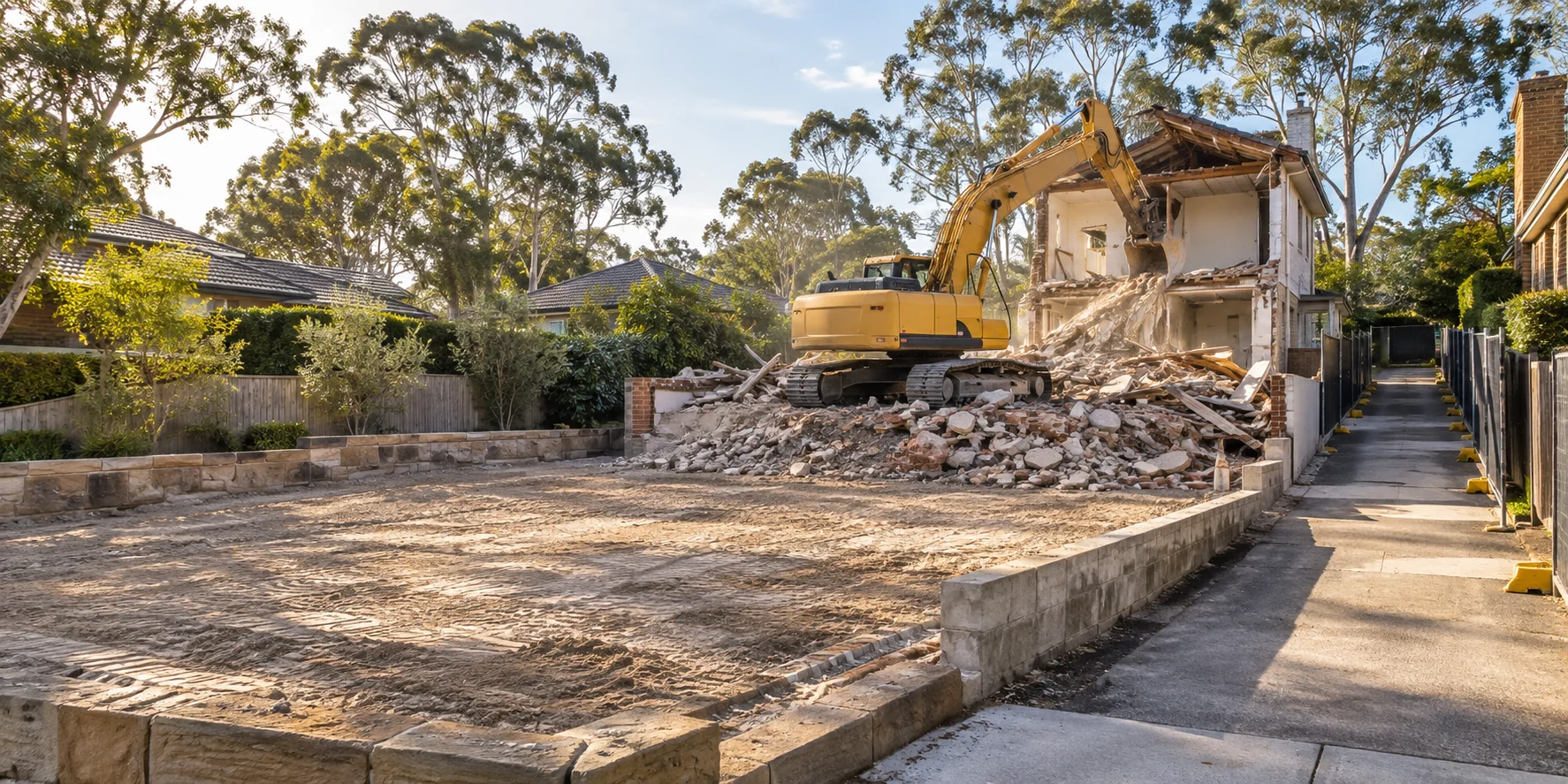
AI-generated illustration for Sutherland Shire Residential Demolition, inspired by Sutherland Shire, NSW
DEMOLITION & REMOVAL

Sutherland Shire Residential Demolition

From a complete home removal to an outbuilding, plan residential demolition around neighbours, access and the structures you want to keep.

SUTHERLAND SHIRE, NSWRESIDENTIAL   /   COMMERCIALAI-generated site illustration
YOUR SITE. THE RIGHT APPROACH.

Residential Demolition in Sutherland Shire

Every home has its own construction, access and neighbours, and Sutherland Shire Residential Demolition should be planned around all three. We assess the structure, identify hazardous materials and confirm service disconnections before the first panel comes down.

Tell us about your block, the type of dwelling and what you plan to build or do next. That detail lets us scope the work properly, sequence the trades involved and keep the process clear from approval through to the final site clean.

Homeowners in Sutherland, Engadine, Jannali and Menai often face steep blocks, tight streets and established gardens. We manage dust, noise and truck movements with care, so the demolition respects the street while your project moves forward.

Explore the scope ↓
01 Site review
and access
02 Clear written
scope
03 Defined site
handover
LET'S TALK ABOUT YOUR SITE

Get A Free Estimate

Tell us about the job. Save your project details, then call us to discuss a quote.

Your brief downloads to your device. No enquiry is sent. Call 00 0000 0000 to discuss your project. Privacy information.

Residential Demolition Services in Sutherland

01

Home Assessment and Planning

Each dwelling is assessed for construction type, hazardous materials and access, giving you a clear scope, a realistic timeframe and a safe plan before any machinery arrives on your property. We explain each stage so you know what happens next.

02

Neighbour and Street Protection

We manage dust, noise, fencing and truck movements carefully, with water suppression, shade cloth screening and agreed working hours, protecting neighbouring homes and the street so your demolition proceeds with minimal disruption to the surrounding community, reducing complaints and delays.

03

Utility Disconnection Coordination

Water, gas, power and sewer connections must be isolated before demolition, and we coordinate this process with the relevant utility authorities and your own licensed trades, so the work proceeds safely and compliantly from start to finish, every single time.

WHOLE HOUSE OR PART OF THE PROPERTY

Complete removal or selective residential work

Whole-property clearance

  • House, outbuildings and often paths and fences
  • Usually leads to a rebuild or subdivision
  • Approval and waste planning at full scale
  • Site is left empty and fenced

Part of a residential site

  • Granny flat, pergola, extension, carport or outbuilding
  • The main house stays occupied or retained
  • Protection of what remains is the priority
  • Services and structure need checking at the join

Describe exactly what stays. The more clearly the line is drawn, the fewer surprises on the day.

LIVING NEXT TO THE WORK

Residential Demolition Experts in Sutherland Shire: How We Do The Job

  1. Site walk

    Walk the property with the supervisor. Point out boundaries, fences, trees, driveways and anything shared with neighbours. Mention any known pipes, tanks or soft ground, and agree where the machine, skip and trucks will sit so nothing important is damaged.

  2. Protect and fence

    Temporary fencing, tree protection and covers for retained paving or garden areas go up first. Site signage and a lockable gate keep children, pets and passers-by out, and protection stays in place until the last truck has left the property.

  3. Isolate and strip

    Services are isolated and fittings are removed by hand so the machine has a clean structure to work on. Any confirmed asbestos must already be removed and cleared, otherwise the strip stops until a licensed removalist has finished that work.

  4. Demolish by sections

    Work proceeds in a planned order, often starting furthest from what is being kept, with water for dust control. Sections near the retained house or neighbouring fences are taken down slowly, sometimes by hand, to limit vibration and falling debris.

  5. Cart and clean up

    Debris is loaded out in trucks sized for the street, and the area is raked or swept to the agreed finish. Kerbs and footpaths are swept clean as work goes, and you receive tip dockets showing where each load went.

HOMEOWNER TRAPS

Common Residential Demolition Mistakes in Sutherland Shire: How To Handle Them

01

Tight street, big truck

Narrow streets and parked cars can stop a tipper reaching the site. Ask about parking restrictions or Council permits for heavy vehicles. Cul-de-sacs, steep driveways and low branches matter too, and smaller trucks mean more loads and a longer job.

02

Shared fence damaged

Fences on the boundary belong to both owners. Agree in advance who repairs what and photograph the fence beforehand. If panels must come down for access, arrange temporary fencing so pets and children next door stay safe and secure throughout.

03

Unmapped drain or line

Private stormwater, irrigation and pool plumbing are not on Dial Before You Dig plans. Share any records you hold. Old drainage diagrams, renovation plans or a previous owner can often reveal lines the crew should locate before machines break ground.

04

Machine weight on a driveway

Excavators and loaded trucks can crack pavers and kerbs. Ask for ground protection where surfaces must be kept. Steel plates, timber mats or rubber tracks spread the load, and damaged Council kerbs or footpaths may need repair at your cost.

WHY CHOOSE US FOR RESIDENTIAL DEMOLITION

Why Choose Our Residential Demolition Experts

Your home deserves a demolition team that respects the property, the street and the people living around it. Our experts assess construction type, hazardous materials and access first, then give you a clear scope and realistic timeframe. We handle utility disconnections, protect neighbouring boundaries and control dust, noise and truck movements throughout the job. Skilled operators work safely and efficiently, separating materials as they go to reduce waste. With strong local knowledge of Sutherland Shire blocks and council requirements, we keep the process smooth from start to finish and leave your site clean, level and ready for what comes next.

Talk to our team ↗
AI-generated illustration of residential demolition works in Sutherland Shire
WHAT CAN BE RECOVERED

Post-Residential Demolition in Sutherland Shire

Concrete and brick

Clean masonry can be crushed to recycled aggregate for fill or road base if it is not mixed with rubbish. Plaster, timber or asbestos fragments ruin a load, so masonry is stockpiled separately and kept free of other demolition waste.

Timber

Sound hardwood can be reused. Old treated or painted timber usually goes to general waste. Older Sydney homes sometimes hold hardwood floorboards, joists or bearers worth saving, but they must be identified before the strip so they come out undamaged.

Metals

Roofing, gutters, wiring and steel have scrap value and are easy to separate. Copper pipe, hot water units and steel beams are pulled out during the strip, and recycling metal keeps it out of landfill and lowers overall disposal charges.

Fixtures and fittings

Doors, windows, hot water systems and kitchens can be removed whole if you want to keep or sell them. Say so early. Label each item, agree where it will be stored, and remove it yourself well before the machine arrives.

ASKED ABOUT RESIDENTIAL DEMOLITION

Frequently
Asked Questions

Retained structures, shared access and protection of neighbouring properties.

Ask us about your project ↗
01Can part of a home be demolished while I live in the rest?+

Sometimes, but it needs approval, structural advice and protection for the occupied area, including dust and noise. Ask your certifier and a structural engineer first.

02What about the neighbours?+

Give them notice of dates and hours, photograph shared fences and boundary structures beforehand, and keep a contact number handy.

03Are standard working hours the same everywhere?+

The NSW guideline is 7 am to 6 pm Monday to Friday and 8 am to 1 pm Saturday, with no work on Sundays or public holidays. Your approval conditions may be stricter.

04Can I keep materials from the demolition?+

Usually yes if you tell the contractor before work starts, so those items can be removed carefully rather than broken.

DEMOLITION & REMOVAL

Let’s start your residential demolition project.

Share the address, the access and the result you need.
Details first. Then a plan that suits the site.

Start a conversation ↗00 0000 0000