CONSIDERED DEMOLITION. EXCEPTIONAL POSSIBILITIES.LET’S TALK ABOUT YOUR SITE ↗ 00 0000 0000
Sutherland Shire Demolition
AI-generated illustration for Sutherland Shire Sand Supply and Spreading, inspired by Sutherland Shire, NSW
CIVIL & UTILITY WORKS

Sutherland Shire Sand Supply and Spreading

Arrange sand placement for bedding or site preparation to suit the project specification.

SUTHERLAND SHIRE, NSWRESIDENTIAL   /   COMMERCIALAI-generated site illustration
YOUR SITE. THE RIGHT APPROACH.

Sand Supply and Spreading in Sutherland Shire

Sand plays an important role in bedding, levelling and landscaping, and Sutherland Shire Sand Supply and Spreading puts the right material exactly where you need it. We supply, deliver and spread to your specified depth.

Tell us your area, intended use and access. Whether it is paver bedding, turf levelling or pool surrounds, the correct sand type and an even spread give you a smooth, stable result.

From Woolooware, Cronulla and Caringbah to Miranda, Gymea and Kirrawee, deliveries must suit narrow streets and tight driveways. Careful handling and tidy spreading leave your site clean and ready for the next stage.

Explore the scope ↓
01 Site review
and access
02 Clear written
scope
03 Defined site
handover
LET'S TALK ABOUT YOUR SITE

Get A Free Estimate

Tell us about the job. Save your project details, then call us to discuss a quote.

Your brief downloads to your device. No enquiry is sent. Call 00 0000 0000 to discuss your project. Privacy information.

Sand Supply and Spreading Services in Sutherland

01

Right Sand for the Job

We supply the correct type of sand for paver bedding, turf levelling or pool surrounds, including washed, paving and fill sands, matched to the task, giving you stable, consistent results suited to your specific project requirements, saving you costly rework.

02

Delivery and Even Spreading

Sand is delivered to your site and spread to the specified depth, then raked out and levelled ready for compaction or screeding, saving you the time and effort of moving heavy material by hand, so your project moves forward faster.

03

Tidy, Ready-to-Use Finish

After spreading, we leave the area clean and smooth, with excess sand removed from paths, driveways and street gutters, ready for pavers, turf or other finishes, with minimal mess for you or your neighbours, ensuring your project finishes on time.

FINE VERSUS COARSE

Bedding sand and fill sand

Bedding or paving sand

  • Finer and cleaner, for levelling under pavers
  • Needs to be screeded to a consistent depth
  • Drains but can wash out if edges are not restrained
  • Used for pavers and under some pipes

Fill or building sand

  • Coarser, used for bulk filling and bases
  • Used under slabs where the design calls for sand
  • Can be used to raise levels in low areas
  • Needs compaction in thin layers

Always match the sand to the job. Ask what the paver supplier, engineer or plumber specifies.

WHERE SAND IS USED

Jobs that call for sand

Paver and path bedding

A level layer of sand under pavers lets them be laid flat and locked in. Depth is controlled with screed rails. It sits on a compacted base, not soil, and fine jointing sand is swept in to lock pavers together.

Pipe bedding and surround

Pipes sit on and in fine sand so rocks do not press on them. The plumber specifies the type and depth. Surround sand goes in on both sides and is lightly compacted, so the pipe stays on line and grade.

Under slabs and sheds

Some slab designs use a sand layer under the membrane. Check the design first, because others require crushed rock. For a shed or garden room, the supplier's slab detail states the bedding, which is screeded level before the membrane goes.

Pool backfill and sand pits

Sand can be part of pool bedding or backfill, and a play sand pit uses a cleaner, fine grade. Pool backfill specification still comes from the engineer or certifier. Play sand should be washed and labelled as suitable for children.

DELIVER, SPREAD, COMPACT

Sand Supply and Spreading Experts in Sutherland Shire: How We Do The Job

  1. Work out the volume

    Area times depth, with an allowance for compaction. Sand is heavy, so check the truck payload and delivery access. Suppliers may sell by the tonne or cubic metre, so confirm the unit, and order extra to avoid a second delivery.

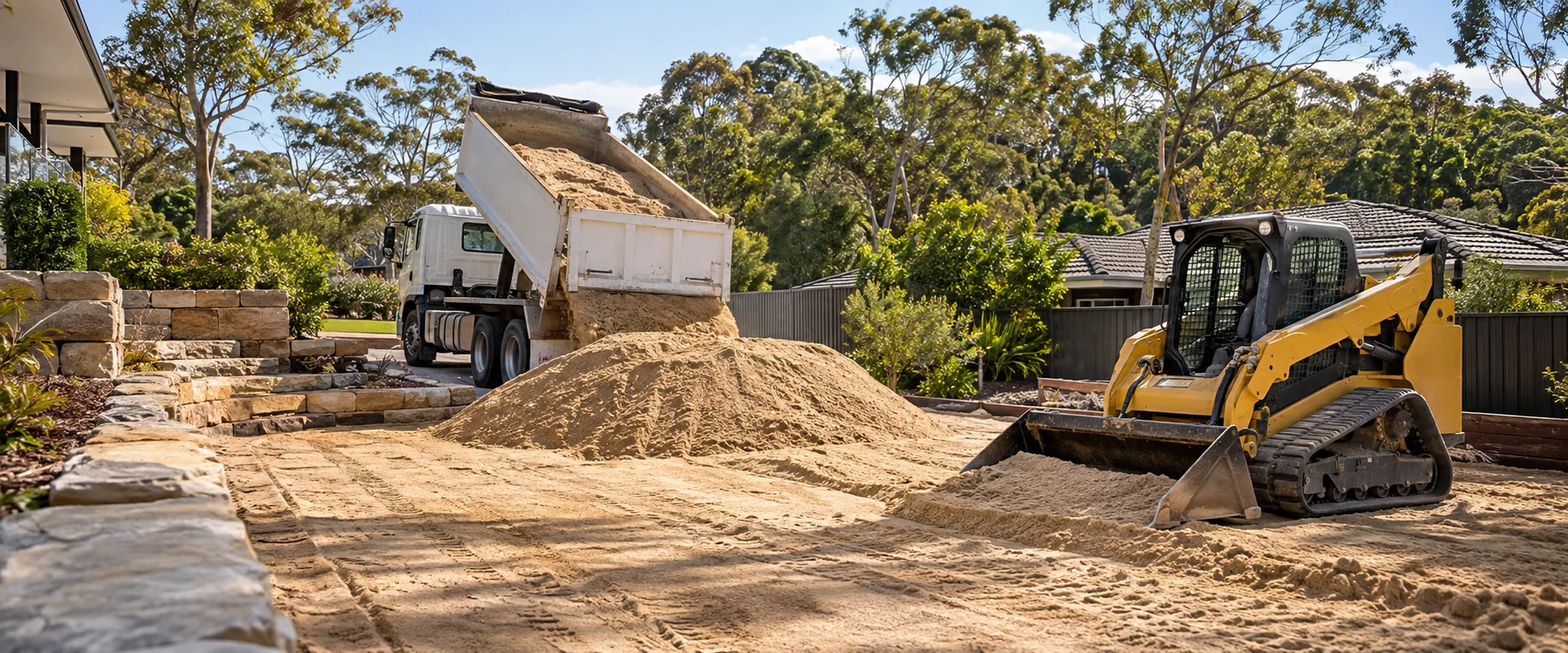
  2. Deliver and tip

    The truck tips at a spot clear of drains and neighbours. Wet sand tips differently from dry sand. Lay a tarp or plywood first on paving or lawn, and check for overhead wires and branches before the tipper body rises.

  3. Spread to levels

    A skid steer or barrow moves it into place. For paving, sand is then screeded to the specified depth. Screeding is done in sections ahead of laying, so the bed is not walked or rained on before pavers go down.

  4. Compact as required

    Fill sand under structures is compacted. Bedding sand for pavers is usually screeded and left uncompacted until the pavers go on. Once laid, the pavers are plate compacted so they settle into the bedding and jointing sand fills the gaps.

SAND TERMS

Sand Supply and Spreading Terms That You Need To Know

Screeding
Dragging a straight edge over the sand to a consistent depth. Rails or pipes are set to level on the base, the straight edge is pulled along them, and the rails are then removed and their channels filled before laying.
Washed sand
Sand rinsed to remove fines and clay, so it drains better. It is commonly used for pipe bedding, drainage layers and some paving. Washing also reduces staining and mud, though it costs a little more than unwashed or brickie's sand.
Concrete sand
A coarser grade used for mixing, bedding and some fill. Its more angular grains lock together better than fine sand and hold shape under load. Check whether your paver supplier or plumber accepts it before substituting it for specified sand.
Fines
Very small particles in sand that affect drainage and compaction. A little helps sand bind and compact, but too much clay or silt slows drainage, stains paving and turns soft when wet. Specifications limit fines for bedding and drainage sand.
Bulking
The change in volume when material is dug or moved. Loose sand or soil takes up more space than in the ground or once compacted, and moisture changes it. Allow for this when converting areas and depths into an order.
Jointing sand
Fine, dry sand swept into the gaps between laid pavers. It locks them together so they share load and do not rock. Some products include a binder that sets when wet, which resists washout and weeds but needs careful application.
WHY CHOOSE US FOR SAND SUPPLY AND SPREADING

Why Choose Our Sand Supply and Spreading Experts

The right sand makes a real difference to bedding, levelling and landscaping results, and our experts help you choose correctly. We supply suitable sand for paver bedding, turf levelling, pool surrounds and more, delivered to your site and spread to your specified depth. Clear communication ensures you order the right quantity and know when it will arrive. Careful handling and tidy spreading keep mess to a minimum for you and your neighbours. With local knowledge of Sutherland Shire narrow streets and tight driveways, we deliver on time and leave a smooth, stable surface that is ready for the next stage.

Talk to our team ↗
AI-generated illustration of sand supply and spreading works in Sutherland Shire
SAND SLIPS

Common Sand Supply and Spreading Mistakes in Sutherland Shire: How To Handle Them

01

Sand washing out

Without edge restraint or drainage control, rain moves the sand out from under pavers. Plan the edges and the drainage. Concrete haunching or fixed edging holds the outer rows, and downpipes should not discharge straight onto paving laid on sand.

02

Wrong sand for the job

Using fine sand where coarse fill is called for, or the reverse, causes settlement. Check the specification. Names vary between yards, so describe the job, not just a product name, and check the delivery docket against the order before spreading.

03

Too much depth under pavers

A thick bedding layer shifts and sinks. The depth is usually kept thin and consistent, so get the base right underneath. Using sand to hide a badly trimmed base leads to uneven pavers, so fix low spots with compacted base.

04

Sand against walls

Piling sand against brickwork bridges the damp course. Keep it below the required level. Sand holds moisture against the wall and can cover weep holes, leading to damp, staining and timber decay. Keep stockpiles away from the house as well.

05

Dumped sand blocking drains

Sand washes into stormwater pits quickly. Contain stockpiles so it does not leave site, as sediment control rules apply. Place deliveries on the property where possible, cover them before rain, and sweep spills from the gutter and footpath every day.

06

Compacting dry fill sand

Bone-dry sand runs loose under a plate compactor and settles later. Fill sand compacts best when evenly damp, so water it lightly and work in thin layers. Saturated sand is just as poor, so let a soaked load drain first.

ASKED ABOUT SAND SUPPLY AND SPREADING

Frequently
Asked Questions

Sand type, required volume and access for delivery.

Ask us about your project ↗
01Is sand the same as topsoil?+

No. Sand is used for bedding, filling and drainage. Topsoil is a growing medium. They are different products for different jobs.

02What sand is used under pavers?+

Typically a clean, screeded bedding sand, but follow the paver supplier or landscape design.

03Can you spread sand with a machine?+

Usually yes, with a skid steer or small loader, as long as there is access. Tight yards may need hand spreading.

04How much sand do I need?+

Area times depth gives the volume, plus a small allowance. Ask the supplier to help convert cubic metres to tonnes, because sand is sold both ways.

CIVIL & UTILITY WORKS

Let’s start your sand supply and spreading project.

Share the address, the access and the result you need.
Details first. Then a plan that suits the site.

Start a conversation ↗00 0000 0000