CONSIDERED DEMOLITION. EXCEPTIONAL POSSIBILITIES.LET’S TALK ABOUT YOUR SITE ↗ 00 0000 0000
Sutherland Shire Demolition
AI-generated illustration for Sutherland Shire Detailed Excavation, inspired by Sutherland Shire, NSW
EXCAVATION

Sutherland Shire Detailed Excavation

Prepare precise building elements where the position and finish matter as much as the volume removed.

SUTHERLAND SHIRE, NSWRESIDENTIAL   /   COMMERCIALAI-generated site illustration
YOUR SITE. THE RIGHT APPROACH.

Detailed Excavation in Sutherland Shire

Some jobs need finesse rather than force, and Sutherland Shire Detailed Excavation delivers accurate digging around footings, services, walls and tight corners. Precision keeps the work to plan and reduces rework later.

Send us your drawings, dimensions and access details. We match the machine and method to the job, working to marked levels and trimming to your tolerances so the next trade can begin with confidence.

From Gymea, Kirrawee and Jannali to Cronulla and Woolooware, detail work is often needed around existing structures and boundaries. Skilled operators and careful setout leave clean, accurate trenches and pads ready for concrete or services.

Explore the scope ↓
01 Site review
and access
02 Clear written
scope
03 Defined site
handover
LET'S TALK ABOUT YOUR SITE

Get A Free Estimate

Tell us about the job. Save your project details, then call us to discuss a quote.

Your brief downloads to your device. No enquiry is sent. Call 00 0000 0000 to discuss your project. Privacy information.

Detailed Excavation Services in Sutherland

01

Precision Around Existing Structures

We dig carefully around footings, walls and boundaries, often using smaller buckets and hand digging close to structures, protecting what is already there while achieving the accurate dimensions your project requires, reducing the risk of damage and avoiding costly repairs.

02

Service Locating and Protection

Existing pipes and cables are identified before digging, using available service plans and on-site locating equipment where needed, and we work carefully around them, reducing the risk of damage, interruption and expensive repair costs to your property, at every stage.

03

Clean, Accurate Trenches and Pads

Excavations are trimmed to marked levels with neat sides and bases, giving your concreter or plumber a straightforward, inspection-ready space to work in, saving everyone time and avoiding rework later. Loose spoil is cleared from the base before each handover.

WHEN PRECISION MATTERS

Jobs where inches count

Pits and pad footings

Lift pits, pump pits and pad footings are dug to nominated sizes. Oversize holes mean extra concrete and backfill and can compromise the design. Undersized holes are just as costly, because formwork or precast units may then not fit properly.

Edge beams and slabs

Slab edges and thickenings follow the engineer detail. The base must be flat and uniform so reinforcement cover and slab depth come out correct. Check that edge beam widths and depths are measured before the concreter starts setting up formwork.

Drain and service runs

Falls on drains are small and unforgiving. A trench dug a little off line or level can leave water pooling in the pipe. Grades should be checked with a laser as the trench goes, not only once at the end.

Next to existing structures

Digging beside a footing or wall means hand work and short sections, so the existing structure is not undermined. An engineer may need to set how close and how deep you can go, and whether underpinning or support is needed.

CONTROLLED DIG METHOD

Detailed Excavation Experts in Sutherland Shire: How We Do The Job

  1. Read the drawings

    Dimensions, depths, and tolerances are confirmed against plans before anything is dug. If something is unclear, the question goes to the designer, not the operator. Check that the drawings on site are the latest approved revision, not an earlier draft.

  2. Mark and offset the pegs

    Set-out pegs get dug out, so offset pegs or strings remain outside the dig to re-check lines later. Record the offset distances clearly, so anyone on site can re-establish a line or level without guessing or calling the surveyor back.

  3. Locate services

    Potholing or hand digging confirms services near the dig line before machine work. Dial Before You Dig plans give an indication only, so exposing the actual pipe or cable shows its true depth and position before the bucket comes close.

  4. Excavate slightly shy

    The machine stops a short distance above final depth, leaving a margin to trim by controlled bucket or hand. This avoids disturbing the ground the footing or slab will sit on, which is hard to restore once it is loosened.

  5. Trim and check

    Final surface is trimmed, measured, and handed back for inspection before the next trade proceeds. Measurements should be checked against the drawings and recorded, ideally with dated photos, so any later dispute about depth or width can be settled quickly.

PRECISION PROBLEMS

Common Detailed Excavation Mistakes in Sutherland Shire: How To Handle Them

01

Machine guidance trusted blindly

Depth and grade systems like iDig only work from a correct benchmark and calibration. They support survey set-out and do not replace it. Check the system against a known level each day and after the machine is moved or serviced.

02

Loose soil left in the base

A thin layer of loose spoil in a footing or pit bottom compresses later. The base should be trimmed clean and firm. Rain, foot traffic and collapsed edges can add loose material back, so check again just before the pour.

03

Undercut sides

Overbreak at the edge of a trench makes formwork difficult and can need extra fill. Ask how the operator controls the sides in sandy ground. Shorter open sections, a narrower bucket and prompt pours all help to limit the damage.

04

Changing the design on site

If a pit or edge has to move, get the revised dimension in writing from the designer before digging further. Verbal changes made on site are easily misremembered, and the certifier or engineer will inspect against the documents, not conversations.

WHY CHOOSE US FOR DETAILED EXCAVATION

Why Choose Our Detailed Excavation Experts

Some excavation needs precision rather than power, and our experts specialise in careful, accurate work. We dig around footings, services, walls and boundaries with controlled methods, locating existing services first to reduce the risk of damage. Trenches and pads are trimmed to marked levels with clean sides and bases, giving your concreter or plumber a straightforward space to work in. Clear communication and careful setout mean fewer corrections and less rework. With local experience across Sutherland Shire homes and constrained sites, we deliver tidy, dependable, accurate results that save time, protect your existing structures and keep your project moving smoothly.

Talk to our team ↗
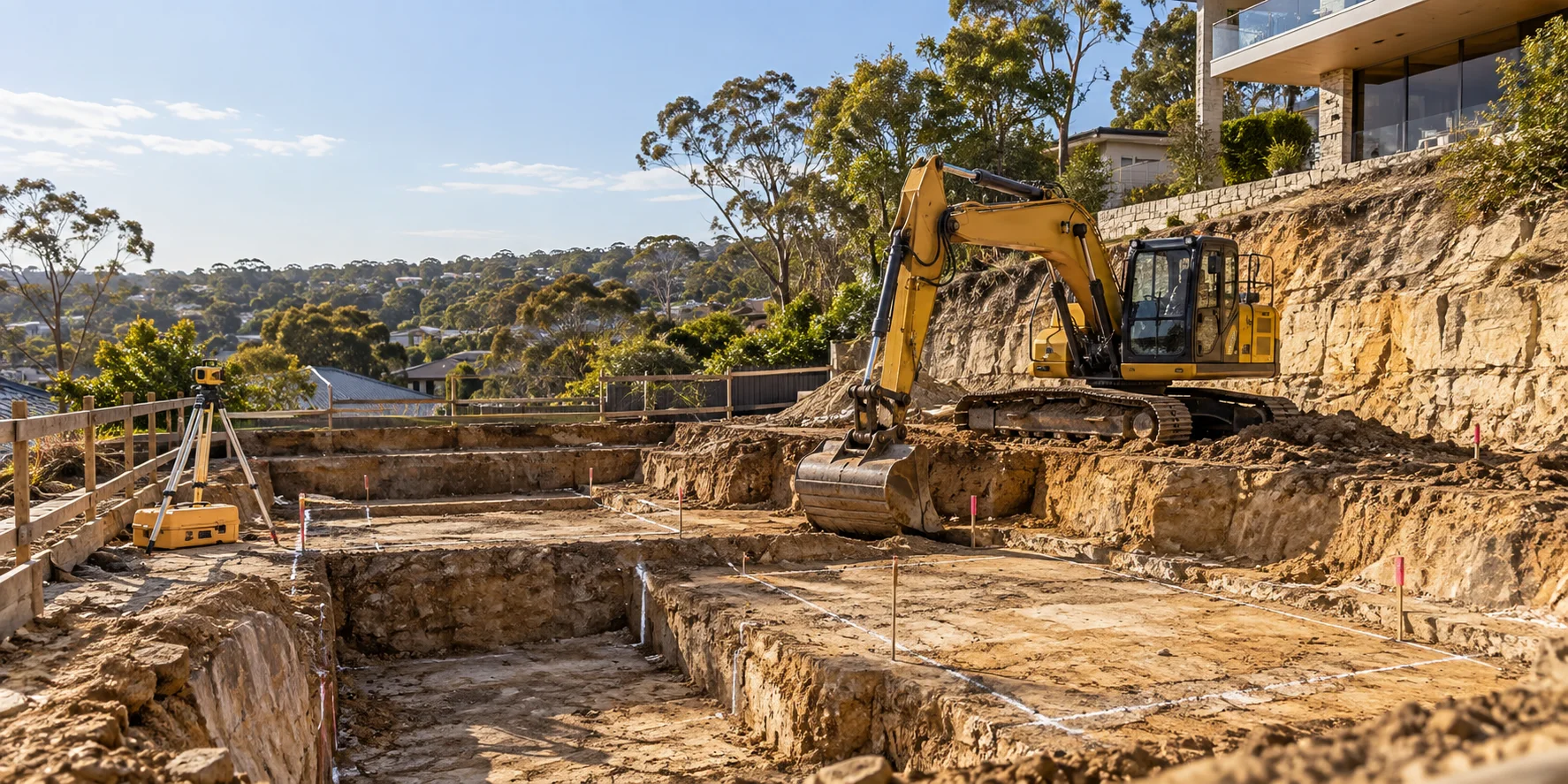
AI-generated illustration of detailed excavation works in Sutherland Shire
PRECISION TERMINOLOGY

Detailed Excavation Terms That You Need To Know

Tolerance
The allowable variation from a nominated dimension or level, set by the designer or specification. Tighter tolerances need more careful digging and checking, so it is worth knowing them before the job is priced and the right machine is chosen.
Offset peg
A marker set clear of the dig that lets lines and levels be re-established after the original peg is removed. It is usually set a measured distance from the line, and should be protected from passing machines, trucks and stockpiles.
Over-dig
Excavation deeper or wider than the design, which usually has to be corrected with compacted fill or extra concrete. Ask your engineer how over-dig should be fixed, because simply backfilling with loose soil leaves a weak layer underneath the footing.
Invert level
The level of the inside bottom of a pipe, pit or channel, shown on drainage plans. Trench depths are worked out from invert levels plus bedding, so each invert should be confirmed against the survey before digging starts.
Pothole
A small hand or vacuum-dug hole to expose a service and confirm its position and depth. Potholing is the usual way to check a marked service before any machine digging nearby, and it helps avoid costly damage and service outages.
Formwork
The temporary mould that holds concrete to shape, which relies on a neat, square excavation. Ragged or overwide trench sides make formwork harder to set out and brace, and may add concrete volume that the original estimate did not include.
ASKED ABOUT DETAILED EXCAVATION

Frequently
Asked Questions

Set-out information, excavation tolerances and adjacent structures.

Ask us about your project ↗
01What tolerance can I expect on a detailed dig?+

It depends on the element and the specification. Your engineer or builder should set the tolerance on the drawings, and your contractor should confirm they can work to it before starting.

02Can a machine really dig this precisely?+

With a skilled operator, a small bucket and a laser or machine guidance for depth, yes, with the final trim finished by hand where needed. Accuracy still relies on correct set-out.

03Why does detailed excavation take longer per cubic metre?+

Operators work in smaller bites, stop to measure and often finish by hand. You are paying for control, not volume.

04Who checks that the excavation is correct?+

The builder, surveyor or engineer should check against the drawings. Ask your contractor to leave the work open for inspection before concreting.

EXCAVATION

Let’s start your detailed excavation project.

Share the address, the access and the result you need.
Details first. Then a plan that suits the site.

Start a conversation ↗00 0000 0000