- Permeability
- How fast water moves through soil. Sand is high, clay low. It decides whether a soakwell is suitable and how large it must be. Fill, compacted ground and rock can lower it, so it is measured on site, not assumed.
- Percolation test
- A field test where water is poured in a hole and the drop timed. The hole is usually dug to the proposed soakwell depth and pre-soaked first. The result guides the design, and a geotechnical engineer may carry it out.
- Setback
- The minimum distance a soakwell must sit from a boundary or building. Setbacks protect footings and neighbouring land from saturated soil. They come from Council requirements and the drainage design, and can be larger on sloping or reactive clay sites.
- Leaf trap
- A filter in the inlet that catches debris before it enters the well. It should be easy to reach, because a trap that is never emptied eventually blocks the inlet and sends roof water spilling back out of the downpipe.
- Perforated unit
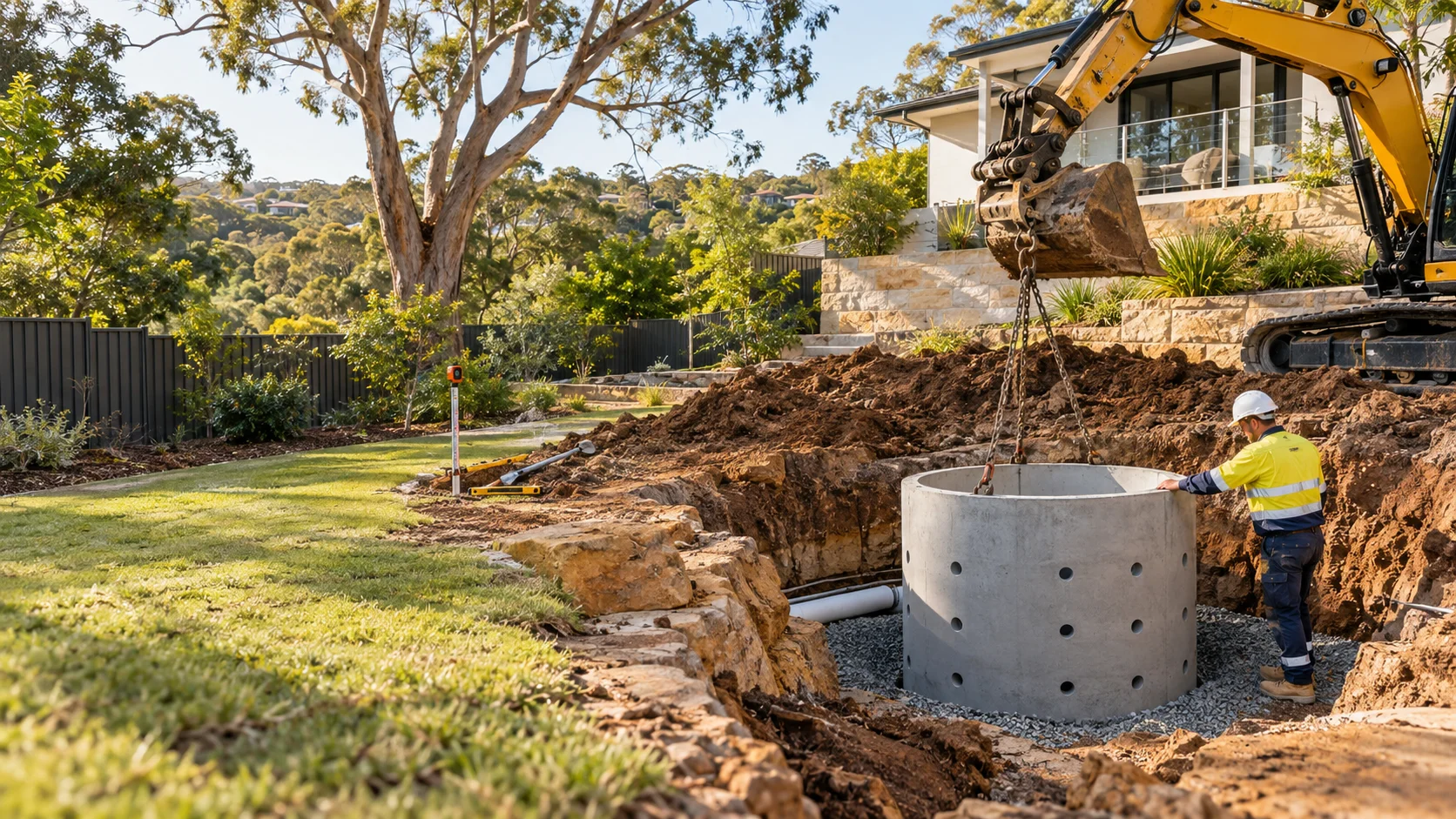
- The precast concrete or plastic chamber with holes or slots in its walls and base. It stores roof water during a storm and lets it seep out gradually. Units come in set sizes, and several can be linked where one is too small.
- Overflow
- A planned exit for water when the soakwell is full, such as a grated lid or a pipe to a surface outlet. It should spill onto your own land away from buildings, never toward a neighbour, and is usually shown on the drainage plan.